
Gods of Plinko
🎰 Instant Win of the Day: Gods of Plinko
🎨 Art | 🖥️ Animation | 🔊 Sound
🏢 Studio: 100HP Gaming
🔗 Game Link: https://100hp.game/#our-games
|
RTP:
96.31%
|
Volatility
High
|
⭐ WHY IT MATTERS ⭐
Gods of Plinko stands out through its competitive dual-world presentation and high-intensity arcade pacing, transforming the familiar Plinko mechanic into a visually responsive mythological showdown between Zeus and Hades. 100HP Gaming blends progression-driven environmental escalation, a large-scale ball-drop spectacle, and contrasting divine visual identities to craft an experience centered on momentum, power, and escalating tension.
Its greatest creative triumph lies in how every dropped ball directly contributes to the visual evolution of Olympus and the Underworld, making the progression throughout the gameplay feel vivid, reactive, and mechanically expressive.
🎨 ART
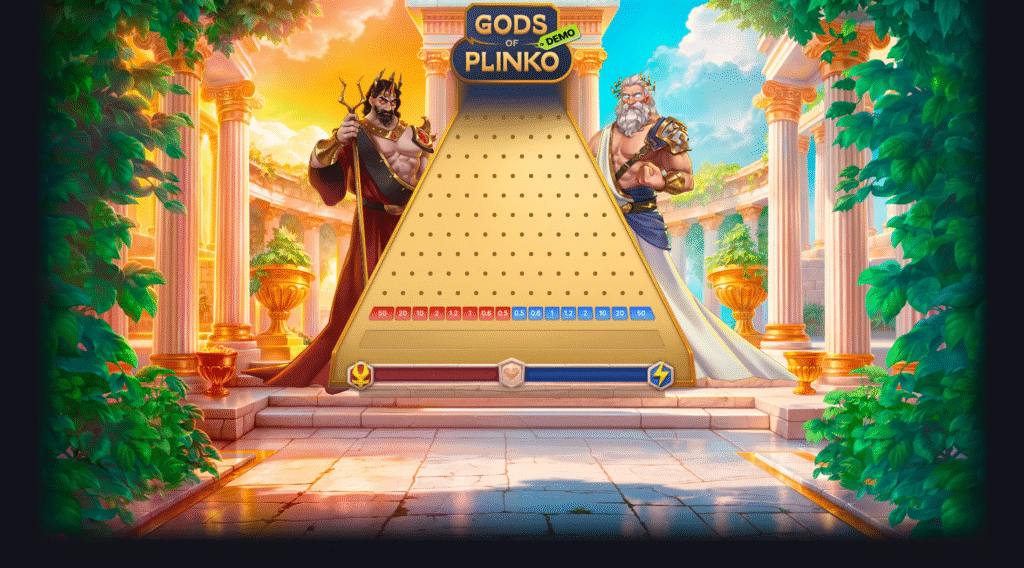
Gods of Plinko offers a highly immersive, Greek mythology-inspired casual gaming experience, transforming the familiar Plinko format into a competitive divine showdown between Zeus and Hades.
The visual direction leans heavily toward electric blues, infernal reds, glowing gold accents, storm-light effects, and Underworld-inspired shadow tones, creating a dual-atmosphere structure that clearly distinguishes the visual identities of Zeus and Hades. Rather than treating mythology merely as static decoration, the game integrates the divine conflict directly into its progression systems, allowing the environment itself to react as each faction gains power.
Zeus’s side emphasizes celestial lighting, the energy of lightning, and radiant Olympus-inspired visuals, while Hades’s side introduces dark volcanic textures, crimson glows, and Underworld symbolism. This contrast creates a strong visual balance, reinforcing the central mechanic of competing divine forces.
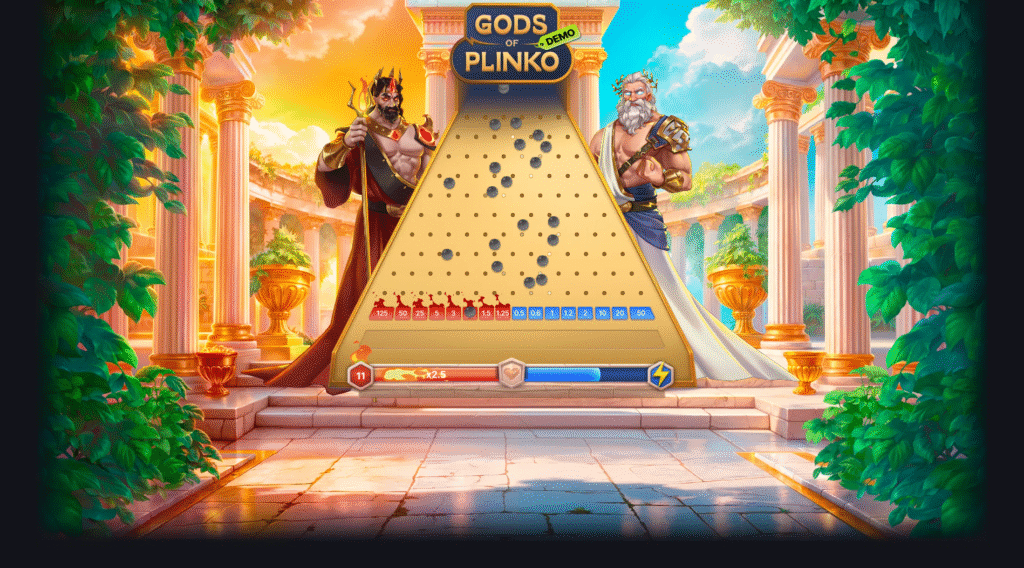
The Plinko board also becomes the visual focal point of the experience. Multipliers, progress bars, and ball-drop interactions are cleanly integrated into the environment, providing the game with a presentation style that is both highly legible and visually charged.
The visual design centers around reactive progression systems and feature-integrated visual feedback. Each dropped ball visually contributes to the Divine progression bars, creating a constant sense of advancement throughout gameplay and heightening anticipation.
A major visual strength stems from the multiplier-boosting mechanic. Once Zeus or Hades fills their respective progress bar, the entire visual state of that side intensifies. Zeus-side multipliers receive a dramatic x10 enhancement, while Hades-side multipliers receive a x2.5 boost, visually transforming the board through intensified lighting, stronger glow effects, and heightened environmental energy.
The environmental division between Olympus and the Underworld is executed with strong thematic clarity. Zeus-related visuals are bright and electrically charged, whereas Hades-related scenes introduce dark contrasts, fiery highlights, and intense atmospheric weight. This dual-world composition helps maintain visual variety while preserving strong gameplay readability.
The ability to launch up to 100 balls simultaneously further reinforces the visual spectacle. During high-volume drops, the board is filled with cascading motion, glowing multiplier interactions, and layered visual feedback that reinforces recognition driven by the game’s pace.
The art direction creates an atmosphere that heightens the sense of divine rivalry and arcade-style spectacle, where every ball drop contributes to a grand mythological battle between opposing forces. Reactive visual progression systems ensure that gameplay momentum is consistently reflected through environmental intensity and multiplier evolution.
Rather than relying on traditional slot-world storytelling, the game succeeds through a mechanic-driven visual identity. The combination of Greek mythology themes, side-based progression systems, and a large-scale ball-drop presentation grants “Gods of Plinko” a strong contemporary identity within the increasingly common iGaming genre.
🎞 ANIMATION
In “Gods of Plinko”, animation is driven by high-density ball-drop interactions and progressive multiplier escalation, creating a gameplay rhythm centered on speed, momentum, and continuous visual feedback. The Plinko structure facilitates dozens of simultaneous interactions across the board, keeping the screen visually dynamic during extended sequences.
The pacing favors rapid acceleration rather than gradual buildup. Each ball contributes instantly to the progress bars of Zeus or Hades, creating a sense of constant advancement and a reactive environmental shift.
The ability to launch 100 balls simultaneously significantly heightens the kinetic intensity of the experience. During these sequences, the board becomes saturated with overlapping trajectories, multiplier effects, particle effects, and divine power animations, all serving to reinforce the game’s identity of “speed and power,” as described by the studio.
A distinct visual identity emerges during the “Divine Progress” activations, which trigger enhanced multiplier states once the progress bars for Zeus and Hades are fully charged. Upon activation, the visual atmosphere intensifies dramatically through environmental transformations, expanded lighting systems, and robust particle effects.
Zeus activations are bolstered by lightning bursts, radiant glow effects, and celestial energy overlays, while Hades sequences introduce fiery transitions and a darkening of the atmospheric ambiance. These visual shifts clearly signal the transition to an enhanced multiplier state while maintaining strong gameplay readability.
The board itself remains highly responsive throughout this progression. Every impact, multiplier interaction, and ball-drop sequence contribute to a sense of fluid motion and heightens the anticipation of potential rewards.
The visual dynamics become particularly striking when both divine meters fill simultaneously, creating a layered spectacle within the Plinko structure where the forces of Olympus and the Underworld collide.
The animation framework creates a mythical arcade spectacle, where large-scale ball drops and reactive multiplier systems generate continuous gameplay momentum. Rather than relying on cinematic cutscenes, the game achieves immersion through environmental responsiveness, visual density, and mechanically expressive motion systems.
The combination of divine-power transformations, high-volume ball interactions, and reactive multiplier escalation lends “Gods of Plinko” a presentation style that feels fast-paced, modern, and highly dynamic.
This creates an experience where motion becomes the primary emotional driver for gameplay progression, generating excitement through constant visual activity and heightening the intensity of divine power states.
🔊 SOUND
“Gods of Plinko” features an audio direction designed to reinforce its mythological conflict and high-speed arcade structure, supporting gameplay through reactive progression cues, divine-energy effects, and escalating feature pacing.
The soundtrack works in close harmony with the visual presentation, emphasizing the energy, momentum, and experiential contrast between the realms of Zeus and Hades.
Sound design plays a pivotal role in reinforcing progression and multiplier growth. Ball impacts, side activations, multiplier boosts, and divine feature triggers are all supported by layered audio cues that heighten anticipation as gameplay progresses.
Zeus-related sequences are reinforced through bright and more powerful tonal treatments, while Hades-related activations emphasize heavy, dark impact tones that underscore their contrasting thematic identities.
As progress bars fill and enhanced multiplier states are activated, the audio framework contributes to a sense of accelerating momentum and heightened reward potential. The potential for two divine factions to activate simultaneously creates a particularly impactful emotional payoff within the gameplay structure.
The audio framework serves as a supportive extension to the game’s mythological progression systems, creating a cohesive audio-visual experience synchronized with ball-drop pacing, multiplier escalation, and side-based feature activations. By maintaining thematic consistency across divine visual identities, reactive progression systems, and energetic gameplay pacing, the presentation remains unified and mechanically expressive throughout the entire experience.