⭐ GAME DETAILS
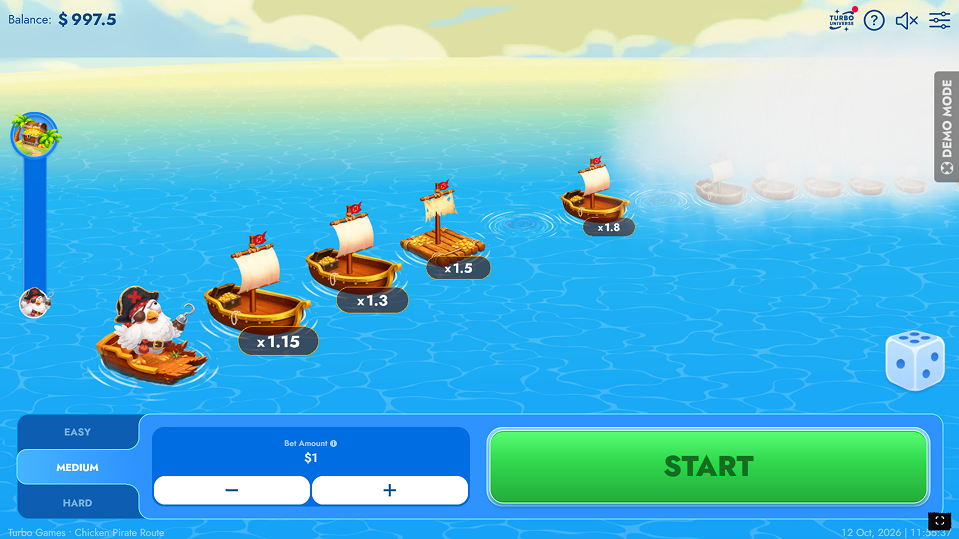
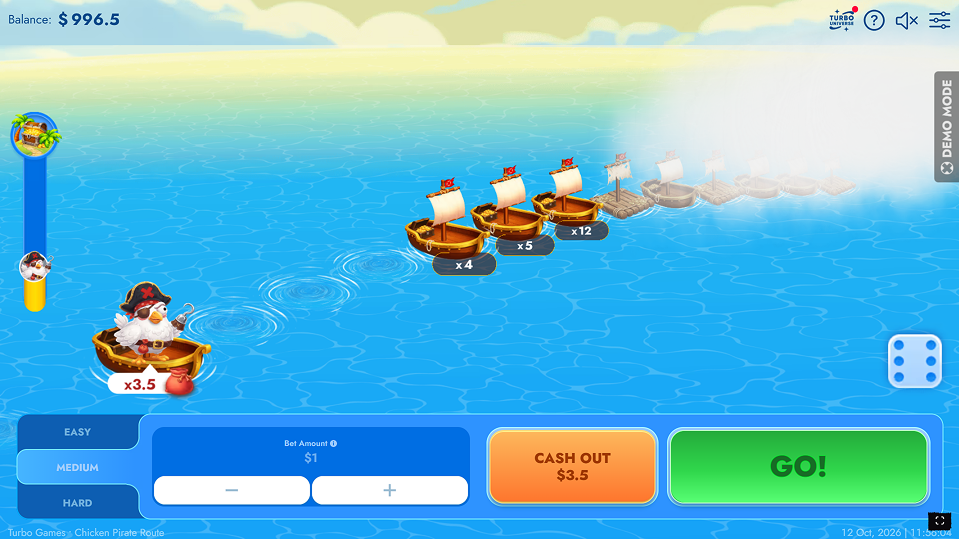
Chicken Pirate Route by Turbo Games is a pirate-themed, stage-based instant win game involving risk, officially launched on May 18, 2026. It combines CrossyRun-style mechanics with a dice-based progression system, where each roll allows the chicken to advance between 1 and 6 positions. The game offers an RTP of 96% and a maximum multiplier of 72,000x. Players can choose between easy, medium, and hard difficulty levels and decide whether to cash out after a successful move or continue advancing toward Golden Island. Additionally, the game features "Provably Fair" technology, allowing players to view the route and potential outcomes before each move.
HIGHLIGHTS OF INNOVATIVE FEATURES
The most interesting creative choice is the combination of Crossy Road-style progression mechanics with movement controlled by dice.
The traditional "cross the street" concept, as seen in games like Frogger, typically relies on predictable, step-by-step movement. Chicken Pirate Route introduces uncertainty by having a single die roll determine how far the character advances, ranging from 1 to 6 spaces.
This creates an intriguing balance between visibility and uncertainty: the player can see the path and the potential dangers ahead, yet the dice dictate exactly how far the chicken will travel.
This imbues every move with a heightened sense of anticipation.
Chicken Pirate Route adapts the classic "road crossing" concept into a pirate treasure-hunting adventure.
The chicken transforms into a small pirate character traveling across ships, wooden rafts, and open water en route to Golden Island. This creates a much more intense sense of a journey compared to a standard road-crossing setting, as the destination is visually linked to the player's progress.
The pirate setting also provides a natural opportunity to introduce hazards. Instead of cars and traffic, the player faces treacherous waters, sharks, octopuses, and gaps between vessels. This makes the environment feel like a genuine adaptation of the game mechanics, rather than just a superficial visual reskin.
Golden Island serves as a particularly effective visual objective. It gives the player a clear goal to move toward and fosters a sense of accomplishment upon completing the route.
The environment clearly conveys the game's risks. Safe platforms represent progress, while the surrounding water and hazards symbolize potential failure. This represents a solid, functional art direction, as the environment itself helps explain the rules.
The pirate chicken is intentionally simple and easy to distinguish. This is ideal for a game where the character must remain highly visible while navigating the route.
The pirate style also gives the character an immediate personality without the need for an elaborate backstory or supporting characters.
Therefore, its greatest artistic strength lies not in complexity, but in clarity and thematic integration.
Animation is one of the game's strongest creative elements, as the dice mechanic directly controls the character's physical movement.
Each roll determines the distance the chicken travels, with a potential movement range of 1 to 6 spaces. This creates uncertainty while keeping the interaction extremely simple.
The dice roll becomes a key animation event: the player must instantly grasp the result, watch the chicken move to its new position, and then immediately evaluate whether to continue or cash out their winnings.
One of the smartest design choices is making the path ahead visible before the player commits to the next move.
This gives the player information about imminent dangers, even though the dice determine the actual movement. Consequently, the animation becomes part of the decision-making experience rather than merely providing a visual response.
The player can see the environment, understand the potential danger, and watch as the dice determine how far the chicken travels.
The Easy, Medium, and Hard difficulty levels create varying degrees of risk and potential reward. The maximum possible multiplier reaches 72,000x the bet, giving the final stage of the journey immense aspirational appeal.
The animation reinforces this progression by gradually ramping up visual and audio tension as the chicken advances toward Golden Island.
Arguably, the most important animation moment occurs after a successful move.
The chicken has reached a new position, and the player must decide whether to secure the current multiplier or risk continuing. This pause builds tension without relying on excessive visual effects.
In this way, the character's position becomes a direct representation of the risk the player has accumulated.
The audio direction should reinforce the atmosphere of pirate adventure and treasure hunting while maintaining a smooth, intuitive interaction.
A robust sound palette can be built around ocean ambient sounds, the creaking of wooden ships, dice rolls, splashing water, pirate-inspired musical elements, treasure-related sounds, and effects that signal danger.
The sound of the dice roll should become the game's signature audio element. It marks the moment uncertainty enters the mix, as the player waits to see how far the chicken will advance.
The greatest opportunity for sound design arises immediately after the dice result is revealed.
A successful landing can be accompanied by a brief confirmation cue, whereas dangerous positions might introduce sounds that convey a greater sense of urgency. As the multiplier rises, the musical intensity can gradually increase.
Golden Island should deliver the most impactful audio reward, as it represents the journey's final destination.
Thus, the sound design has a relatively straightforward objective: to make every move feel significant without disrupting the flow of interaction.