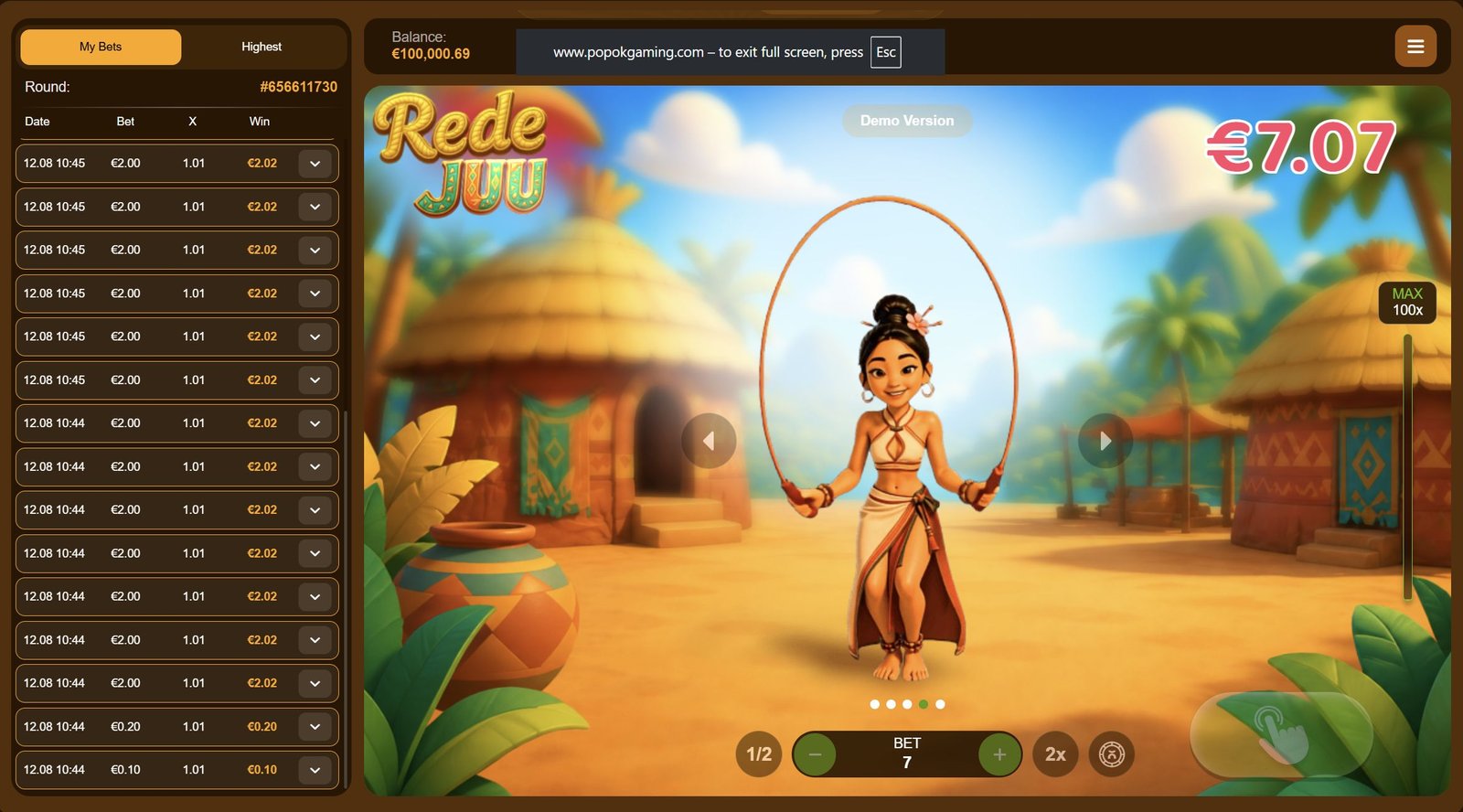
⭐ GAME DETAILS
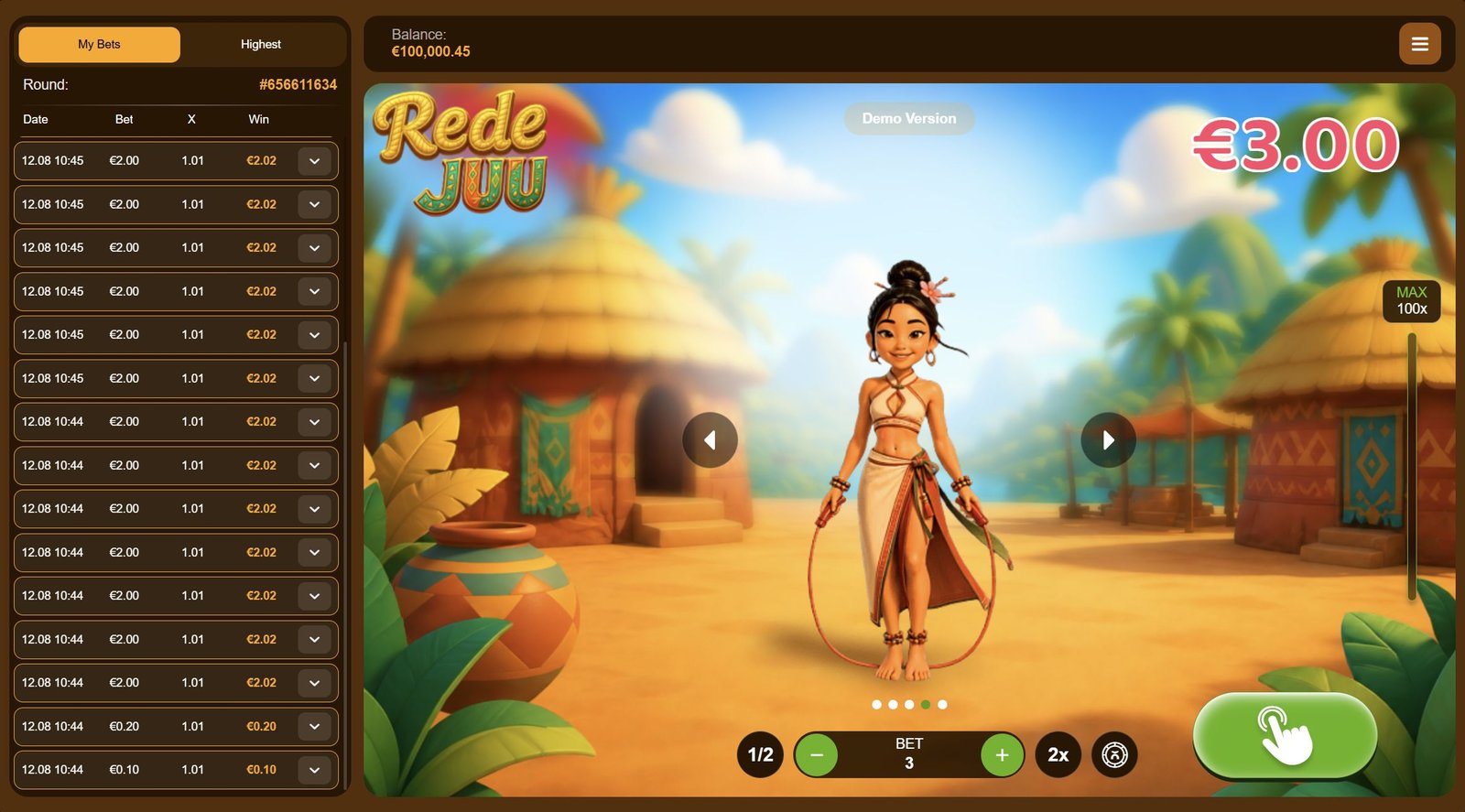
Rede Juu by PopOK Gaming is an African-themed "crash" style instant-win game, released on June 19, 2026. It utilizes a "Hold-to-Ride" mechanic, where players press and hold the game button as the multiplier rises, releasing it to cash out their winnings before the crash occurs.
The game also includes a progressive jackpot, a "provably fair" system, and leaderboards, adding social and competitive elements to the core crash style gameplay.
The combination of a "press-and-hold" mechanic, five selectable characters, real-time leaderboards, a provably fair system, and a maximum 100x multiplier gives the game a unique identity without sacrificing the simplicity of its primary interaction.
Highlights of Innovative Features
The player becomes part of the mechanics
The most interesting creative decision in Rede Juu is the physical interaction of holding down a button to move forward.
The player does not simply watch a multiplier and decide when to press a button; the act of holding it down is part of the risk.
This creates a direct relationship within the gameplay:
Holding down = continuing to advance = increasing the potential reward.
Releasing too soon reduces the opportunity. Releasing too late can lead to a crash that ends the game.
It is a simple mechanic, but its strength lies in the direct connection between the player's physical action and the risk reward system.
The first impression is one of visual cleanliness, featuring the character as the focal point and emphasizing interaction.
Rede Juu deliberately avoids the visual complexity of conventional slots. There are no reels, paylines, or large symbol grids competing for attention. Instead, the visual hierarchy focuses on:
Character → Multiplier → Rising tension → Cash-out
This approach suits an instant-win game, where the player's attention must remain fixed on a single decision.
The African inspired setting gives the game a distinctive identity while maintaining a relatively simple presentation.
A key creative decision is to avoid interface clutter. Decorative elements take a backseat to the multiplier and the character, allowing the player to grasp the game almost immediately.
In this way, simplicity serves a functional purpose rather than being merely aesthetic.
The option to choose from five characters is a smart move for a game that lacks traditional slot symbols.
Character selection allows players to personalize the experience before the high-stakes sequence begins. More importantly, it provides a stronger emotional anchor than a purely numerical "crash" game interface.
Thus, the characters function much like a mascot or avatar in arcade games.
The interface must convey information instantly. The multiplier needs to remain the visual focal point, while the setting creates atmosphere without distracting the player from the decision to cash out.
Animation is the fundamental creative discipline of Rede Juu.
The gameplay dynamic is extremely straightforward:
Bet → Hold down → Multiplier rises → Release → Cash out or lose it all (crash)
The game's most distinctive interaction is the "hold-to-ride" mechanic.
Instead of simply pressing a cash-out button, the player must physically keep the game button pressed to stay in the round.
This establishes a direct relationship between:
Physical action → Time → Multiplier → Risk
This approach is particularly effective for an arcade-style experience, as the interaction is immediately understood.
It is during the multiplier's rise that the animation system must generate tension.
At low values, the presentation can remain controlled. As the multiplier climbs, visual movement and intensity can gradually increase, building pressure around the decision to cash out.
The maximum 100x multiplier gives the progression a clear visual goal and makes the final phase of the experience feel aspirational.
The sound design should heighten tension rather than emphasize visual spectacle.
The key audio layers are:
- rising multiplier tones
- rhythmic background music
- character related audio cues
- cash out sounds
- crash impact
- big win celebrations
- leaderboard and social feature feedback
This differs fundamentally from a traditional slot machine. The sound does not need to react to dozens of symbols; its primary goal is to ensure the rising multiplier conveys a sense of mounting danger.
The greatest audio opportunity lies in the gradual escalation.
As the multiplier rises, the soundtrack can progressively intensify through changes in pitch, tempo, and the addition of extra layers. This creates a sense of urgency without relying on excessive visual effects.
The moment of the crash must offer a stark contrast. After a sustained build-up of tension, an abrupt cut in sound can make the outcome feel immediate.
The cash-out moment requires a distinct sonic identity, allowing the player to instantly distinguish a successful decision from a failed round.