
⭐ GAME DETAILS
Knight's Ascent is a medieval fantasy "crash" game developed by Nobles Gaming.
The gameplay mechanics are based on level progression and an ascending multiplier; players must decide whether to keep advancing in pursuit of a potentially larger reward or to cash out their winnings before the round ends abruptly. The game also includes a Bonus Buy feature.
Most medieval games focus on battles, treasure hunts, or heroic quests.
HIGHLIGHTS OF INNOVATIVE FEATURES
The game's most interesting creative decision is to turn risk into physical distance.
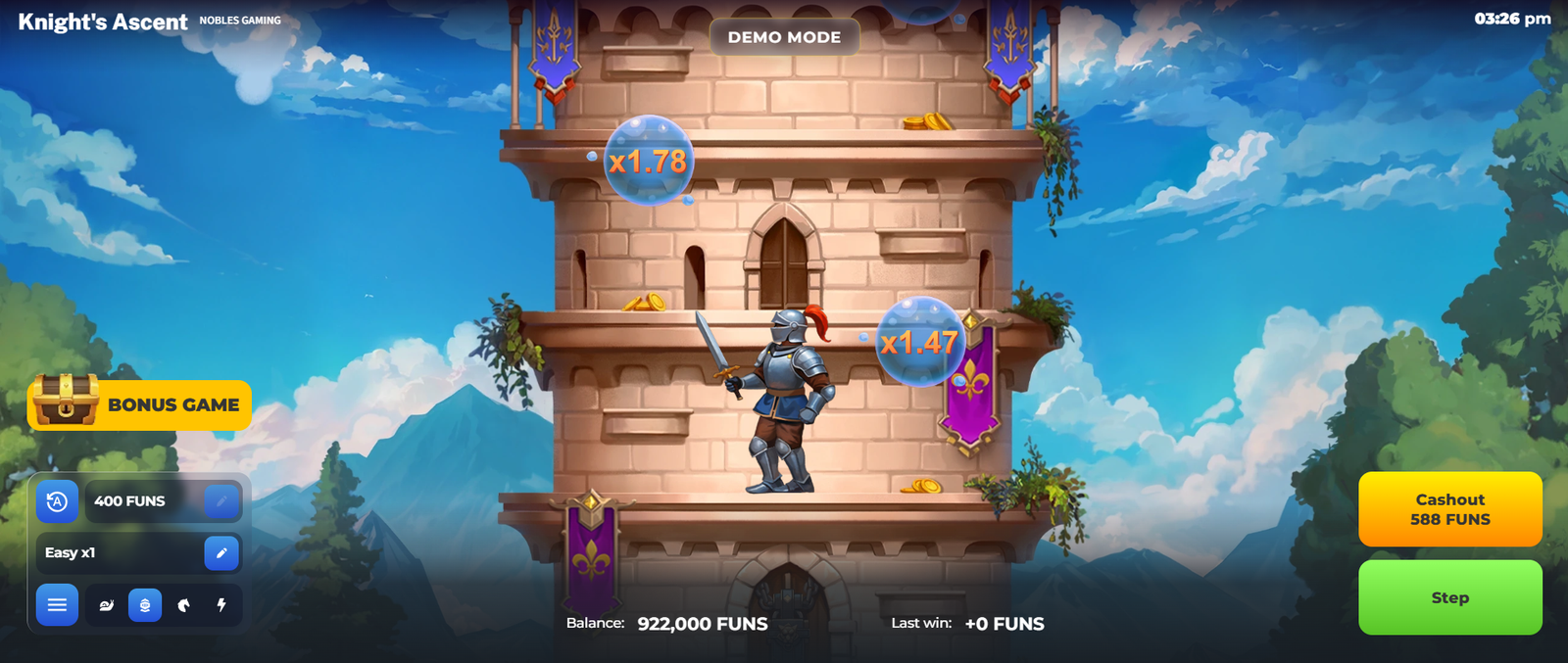
The multiplier is not simply displayed on a conventional interface; the knight's position represents the player's progress.
Thus, every additional step carries two meanings:
- Greater distance covered.
- Higher potential reward.
- Greater risk.
This makes the game's visual language unusually functional.
The first impression is one of simplicity.
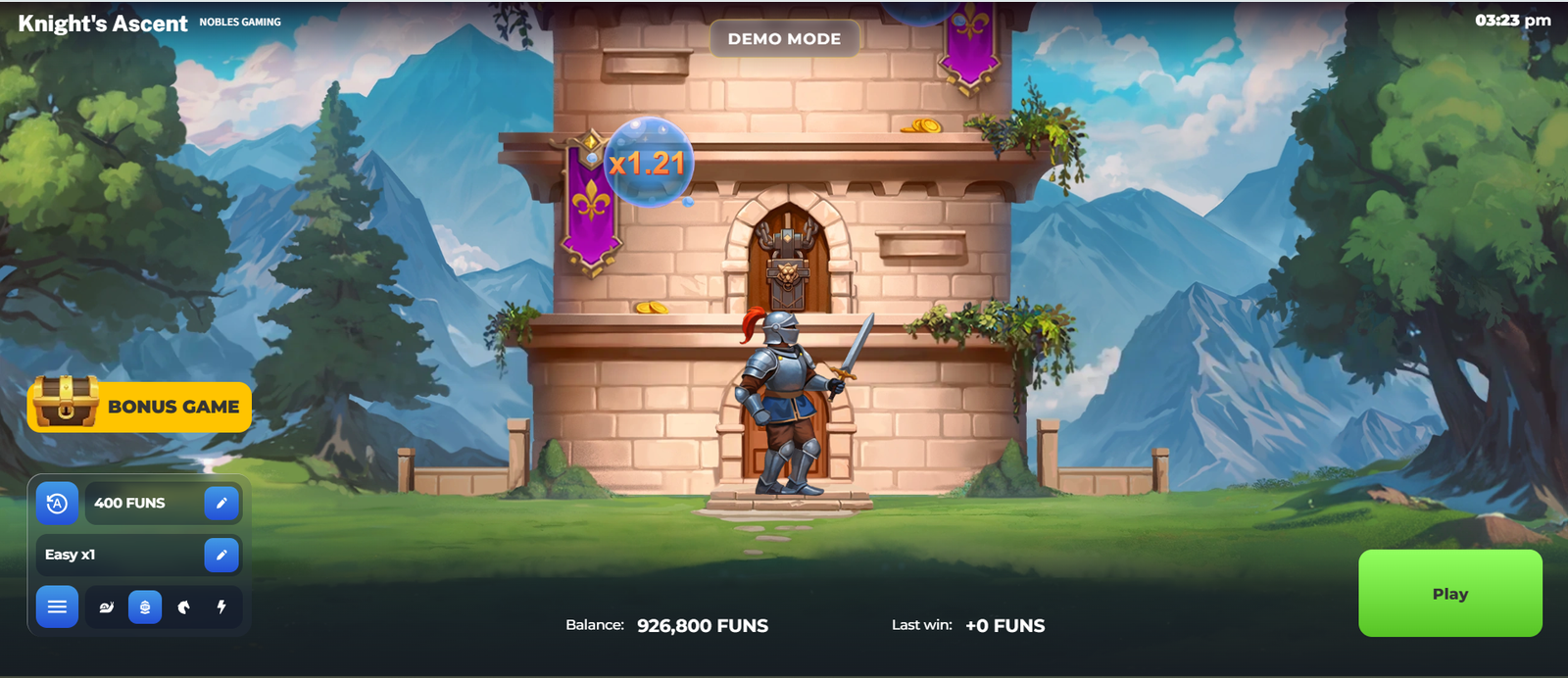
Instead of presenting a conventional fantasy slot game packed with symbols, characters, and decorative elements, Knight's Ascent focuses almost exclusively on a single knight and the tower standing before him.
That restraint is significant.
The tower serves as the game's visual progression system. Each successful leap physically brings the knight closer to the summit, allowing the player to instantly see where they stand on the 50-step journey.
The medieval architecture quickly sets the scene. Stone walls, raised platforms, suits of armor, and castle structures create a recognizable fantasy setting without interfering with the gameplay mechanics.
Furthermore, the knight is more than just a graphic element; his movements convey the outcome of every decision. When he climbs, the player senses the progress; when the climb ends, the visual ascent halts.
Animation is the creative discipline that defines the game.
The core sequence is simple:
Choose your risk level → The knight ascends → The multiplier increases → Decide whether to continue or cash out.
Each successful step provides immediate visual feedback. The knight moves up, the multiplier rises, and the player faces a new decision.
This creates a strong connection between movement and the consequences within the game mechanics.
Consequently, the most compelling moment of the animation isn't necessarily the celebration of a big win, but the brief instant before the next move. The player knows that taking another step could boost the multiplier but it could also end the game.
This generates tension through anticipation rather than visual spectacle.
The 50-step structure reinforces this feeling: the higher the knight climbs, the greater the significance of the physical distance covered.
The animation also benefits from avoiding an overcrowded experience. With no conventional reels to animate, the knight's movement, environmental transitions, and the multiplier display carry virtually the entire experience.
The result is a clean progression system where the animation directly communicates the relationship between risk and reward.
Sound design presents a different challenge than that of a conventional slot machine.
It requires building tension rather than creating a sense of constant celebration.
The medieval setting naturally lends itself to the use of orchestral percussion, the sounds of metal armor, impacts against stone, footsteps, and musical layers of increasing intensity. These elements reinforce the physicality of each ascent, keeping the atmosphere grounded in the knight's journey.
The most important audio moment is the successful completion of a step.
A clear auditory cue confirms the knight's progress, while musical layers of rising tension convey that the stakes are getting higher.
The decision to cash out winnings is particularly significant. Instead of overwhelming the player with constant sound effects, the soundtrack can create space and build anticipation for the next move.
This restraint aligns with the game's risk-based structure.
The audio does not need to tell the player that every moment is thrilling; its role is to spark curiosity about what will happen next.