
Chicken X
🎰 Slot of the Day: Chicken X
🎨 Art | 🖥️ Animation | 🔊 Sound
🏢 Studio: Million Games
🔗 Game Link: https://www.milliongames.com/games/chicken-x
🎨 ART
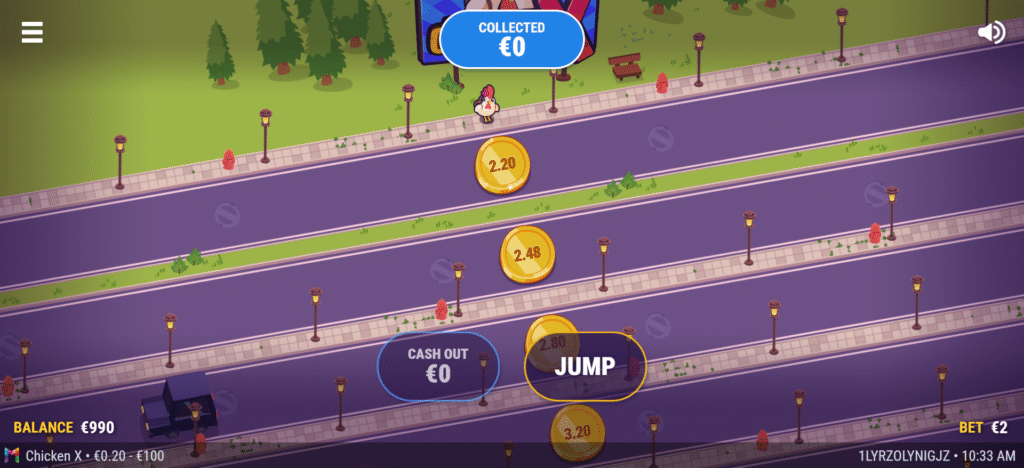
Centred around the universally recognizable image of a chicken crossing a busy highway, Chicken X adopts a minimalist, arcade-inspired visual identity. The design departs from traditional slot machine narratives, focusing instead on a clean, structured environment defined by road lanes, moving vehicles, and the protagonist. This approach creates an immediate and intuitive visual language in which danger and progress are clearly communicated.
The color palette is functional and direct, utilizing strong contrasts between road surfaces, lane markings, and moving objects to maintain clarity during fast-paced gameplay. The absence of decorative complexity reinforces the arcade nature of the experience, ensuring that every visual element serves a specific gameplay purpose.
The visual execution reflects precision and clarity. The chicken character is designed to appear consistent and legible across all gameplay states, serving as a stable focal point amidst constant motion. Environmental elements, such as vehicles, lane dividers, and coin indicators, are rendered with clean geometry and sharp contrast, facilitating rapid identification.
The simplicity of the layout is a deliberate design choice, allowing each element to function without visual interference. This results in a highly readable interface where decision-making is supported by clear visual cues rather than decorative layering.
The art direction creates a sense of immediate and controlled tension. By stripping away narrative complexity, the visual design focuses on moment-to-moment progression, where every movement carries a consequence. The environment becomes a stage for risk and reward, reinforcing engagement through clarity and momentum.
This stripped-down approach leads to a focused creative identity, wherein visual simplicity heightens the intensity and responsiveness of the gameplay.
🎞 ANIMATION
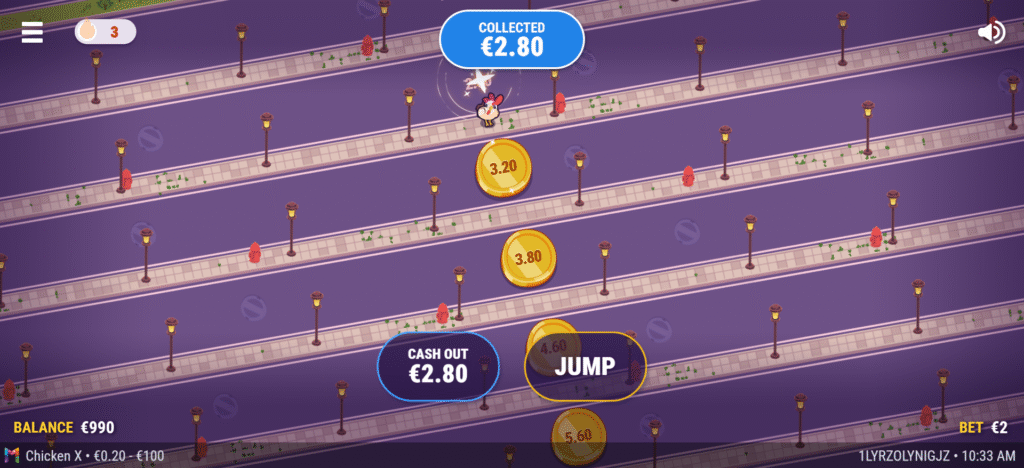
In Chicken X, animation is central to an experience driven by continuous forward motion and reactive timing. The chicken advances incrementally across lanes, while vehicles move dynamically, creating a constant interplay between player input and environmental movement. This establishes a distinct and engaging rhythm.
The motion design emphasizes responsiveness, ensuring that every action feels instantaneous and aligns with the player’s decisions. The fluidity of movement supports a seamless gameplay loop, remaining visually cohesive even as the pace accelerates.
Traditional slot transitions are replaced by progress-based feedback. Each successful step forward serves as a transition point, with visual cues reinforcing progress and raising the stakes. The accumulation of coins and multiplier progression are directly linked to character movement, establishing a clear connection between the animation and the outcome.
As difficulty levels increase, the pacing of the animation accelerates, introducing more complex movement patterns that reinforce the sense of escalation. This ensures that progress is both visible and intuitive.
While the game does not maintain a cinematic presentation in the traditional sense, it offers a high-intensity experiential loop. Constant movement, combined with escalating difficulty, creates a rhythm of tension and release that defines the experience.
The absence of layered transitions allows the animation to drive the engagement, resulting in a focused and mechanics-driven visual experience.
🔊 SOUND
The sound design of Chicken X is intimately intertwined with its real-world-inspired setting, incorporating environmental audio such as traffic noise. This grounded audio identity reinforces the core concept of navigating a perilous road, thereby supporting the visual clarity of the theme.
Audio plays a pivotal role in heightening tension. The presence of moving vehicles and ambient sound cues heightens situational awareness, guiding the player’s reactions prior to every movement. As progression continues, the soundscape contributes to escalating the intensity, thereby reinforcing the risk-reward dynamic.
This utilization of environmental audio ensures that immersion is driven by realism rather than musical complexity.
From a production standpoint, the audio design is precise and functional. Sound cues are tightly aligned with gameplay events, ensuring both clarity and responsiveness. The balance struck between ambient noise and interaction feedback creates a cohesive auditory experience that supports both immersion and gameplay focus.