
EXPLORING THE SOFTSWISS IGAMING TRENDS REPORT AND THE FORCES SHAPING REGULATION, AI, TECHNOLOGY, PLAYER EXPERIENCE, REGIONAL MARKETS, AND THE FUTURE OF IGAMING
The iGaming industry is entering a more mature and interconnected phase, with regulation, technology, payments, player protection, localisation, and artificial intelligence increasingly influencing one another.
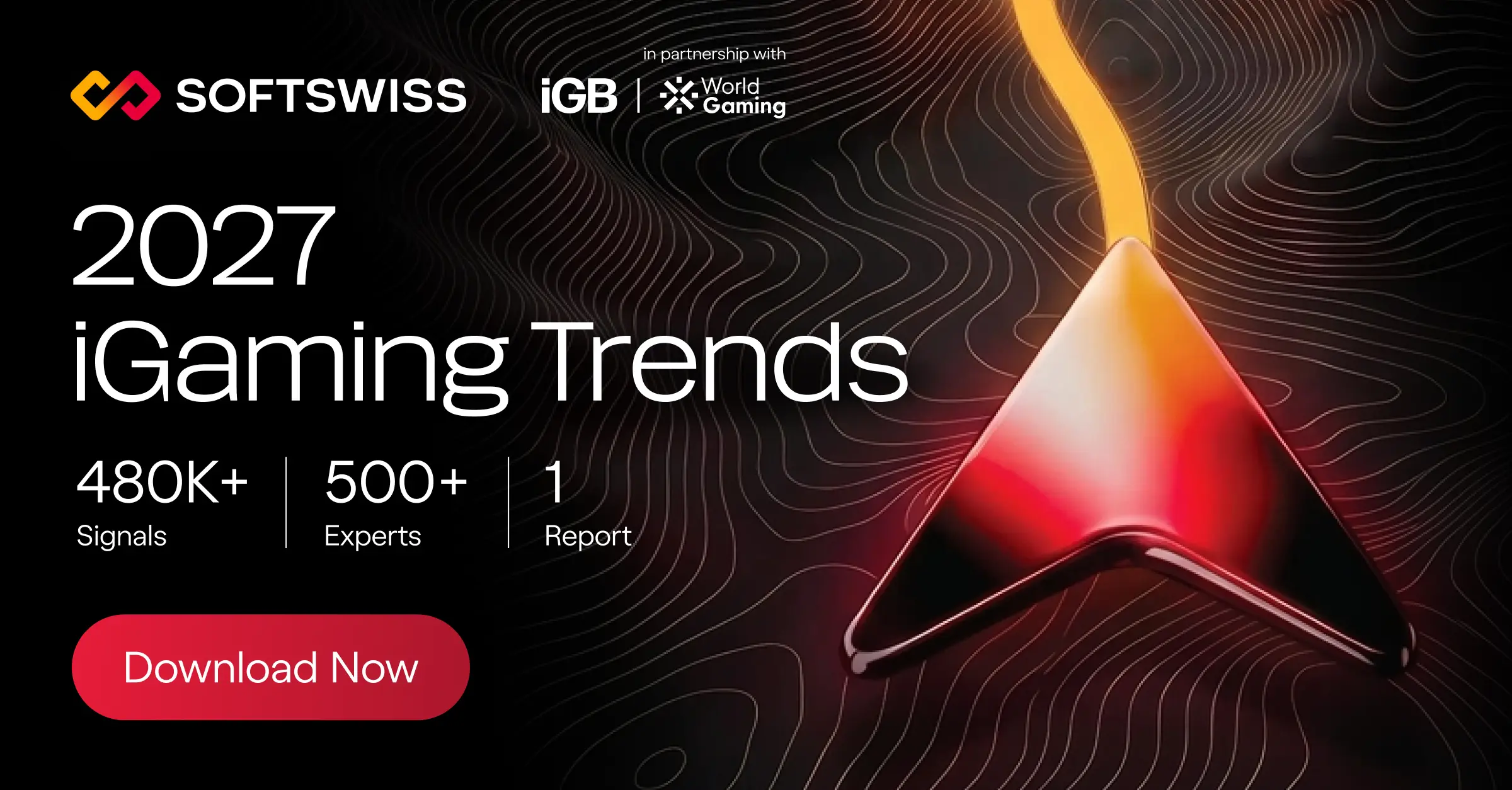
The fifth SOFTSWISS iGaming Trends Report brings together insights from more than 500 industry professionals, analysis of more than 480,000 media headlines, expert interviews, and contributions from partners including WorldGaming and Amazon Web Services. The 2027 edition also expands its perspective beyond iGaming, comparing the sector with developments across other digital industries.
For iGamity, the report provides a useful perspective on the iGaming trends 2027 may bring across technology, regulation, payments, player experience, and regional markets.
IGAMING REGULATION IS BECOMING PART OF BUSINESS INFRASTRUCTURE
Regulation is moving beyond documentation and periodic compliance checks. The report points towards a model where regulators increasingly use shared infrastructure, data, and technology to monitor activity.
The report highlights developments including Portugal's cross-platform self-exclusion system and the EU's Anti-Money Laundering Regulation taking full effect across all 27 member states on 10 July 2027.
The broader direction suggests that compliance will increasingly need to demonstrate that policies work in practice, rather than simply demonstrate that policies exist.
“Regulation. Not as a brake, but as the main engine of sustainable growth. The next wave of iGaming will not be won by companies chasing grey markets. It will be won by companies that understand governments, compliance, payments, taxation, responsible gaming, and local culture. Regulated gaming is the only way forward.”
Eman Pulis
Founder, SiGMA Group
Responsible gambling and player protection are also expected to become more data-driven. The report points to greater attention around affordability assessments, source-of-funds verification, and real-time behavioural monitoring.
“In 2027, the compliance area most likely to undergo the most significant transformation will be responsible gambling and player protection. Regulatory focus is expected to intensify around affordability assessments, source-of-funds verification, and real-time behavioural monitoring to identify vulnerable or at-risk players, alongside stricter measures to prevent underage access.”
Arran McCarthy
Global Commercial Director, EM Group

AI IN IGAMING MOVES FROM PILOTS TOWARDS PRODUCTION
AI in iGaming is one of the most prominent themes in the report.
According to the research, 41.5% of surveyed professionals identified AI as the technology most likely to reshape iGaming. At the same time, many companies remain at the pilot stage rather than having fully integrated AI into production environments.
This changes the nature of the conversation around iGaming technology trends. The focus is moving from experimentation towards implementation, operational efficiency, and the ability to integrate AI into existing business systems.
The report also highlights how technical roles may evolve as AI systems become capable of handling increasingly complex workflows.
“Engineers are moving from individual contributors to managers of AI-powered systems. Instead of writing every line of code themselves, they set the context, define the expected outcome, and guide a fleet of agents through the work - reviewing results and stepping in only at critical decision points.”
Sergey Kastukevich
Chief Technology Officer, SOFTSWISS
AI is also entering regulatory oversight. The report describes a movement from manual review towards continuous and automated pattern detection across licensing filings and performance data. At the same time, regulatory frameworks will need to develop alongside the technology.
The wider SOFTSWISS report also includes analysis from AWS on the movement of AI from pilots into production across gaming, betting, sports, media, and fintech.
PAYMENTS AND OPERATIONAL EFFICIENCY
Technology is also changing the way operators manage financial and operational complexity.
The report points to rising tax burdens in mature markets, including the UK's Remote Gaming Duty reaching 40% and the Netherlands moving towards a 37.8% rate. These pressures can have wider consequences for the resources operators dedicate to technology and operational capabilities.
Automation could play a growing role in managing these processes.
“Operators are forced to maintain entire teams of analysts just to manually adjust routings, tweak limits, and reconfigure cascades - and even then, the system remains 60–80% outdated throughout its entire lifecycle. Over the next 1-2 years, machine learning will take over 90% of routine routing rule adjustments.”
Mikita Revaka
Chief Operating Officer, FinteqHub
The direction suggests that payment routing, limits, configurations, and other repetitive operational processes could increasingly become areas for machine-learning-driven automation.
PLAYER EXPERIENCE IS MOVING TOWARDS CLARITY
As platforms manage thousands of games, increasingly complex bonus structures, promotions, and regulatory requirements, player experience becomes more difficult to manage.
The report highlights a shift in how personalisation is approached. Rather than simply increasing communications or audience segments, personalisation can help players better understand and navigate the overall experience.
“When a provider can deliver not only proven, in-demand content but also an audience already engaged with it, the partnership becomes a double win. Game providers that hold direct player relationships stop being interchangeable content vendors and become traffic and retention partners.”
Marina Ostrovtsova
Chief Executive Officer, BGaming
This also points towards a changing relationship between game providers and operators. Content providers with direct relationships and engaged audiences can bring value beyond the games themselves.

GROWTH IS INCREASINGLY CONNECTED TO RETENTION
The report also identifies an increasingly blurred boundary between sports betting, prediction markets, and entertainment.
Players are increasingly looking for continuous interaction around events rather than simply placing a bet and waiting for an outcome.
At the same time, the report highlights retention and differentiation as increasingly important parts of sustainable growth.
“The trend of 2027 is that growth stops forgiving. Retention and differentiation are the lines between operators who consolidate and those who get consolidated or kicked out. The question is no longer where to find new players - it is why a player would stay with you.”
Viktoriia Grygorenko
Chief Executive Officer, The Playa
The commercial challenge therefore extends beyond player acquisition. The wider experience, product offering, differentiation, and relationship with the player become increasingly important.
IGAMING MARKET TRENDS ACROSS SIX REGIONS
One of the report's strongest messages is that iGaming cannot be approached as a single global market.
Regulation, taxation, payments, player behaviour, and market maturity differ considerably between regions. The report provides perspectives across Europe, Latin America, North America, Africa, Asia and the Middle East, and Oceania.
EUROPE
“Operators must actively diversify their regulatory exposure. Relying on a single licence or jurisdiction is no longer a viable long-term strategy. As regulation continues to evolve, strategic jurisdictional planning is becoming just as critical as product development or marketing strategy.”
Arran McCarthy
Global Commercial Director, EM Group
LATIN AMERICA
“The storm cloud is tax. It always starts operator-friendly, but then it starts to grow. Colombia raised taxes and ended up collecting less - they had to walk it back. If these markets don't learn from what happened in Germany, they'll push their own players straight to the unregulated side.”
Ramiro Atucha
Founder, Atucha Strategic Advisory
NORTH AMERICA
“The US market has and always will be a marathon and not a sprint, as we saw with sports betting. Until these stakeholders can get a single plan, delays will continue to persist at the legislative level.”
Brendan D. Bussmann
Managing Partner, B Global
AFRICA
“The biggest trend in Africa will be the shift from growth at all costs to sustainable, regulated growth. Markets will increasingly reward operators that can demonstrate compliance, responsible gaming, tax transparency, and long-term contribution to local economies.”
Peter Emolemo Kesitilwe
Chief Executive Officer, African iGaming Alliance
ASIA AND THE MIDDLE EAST
“In Asia, the Philippines should remain high on the priority list, especially given the connection between land-based and online gaming. But Asia needs to be approached carefully, as it is not a single market - every country has different rules, player habits, and payment behaviour.”
Miranda Guliashvili
Head of Regional Growth, SOFTSWISS
The report's Oceania section is data-led rather than built around an individually attributed expert quote.
LOOKING BEYOND 2027
The report also looks beyond the immediate iGaming trends 2027 and explores where the industry could be heading over the next 10 to 20 years.
Several themes appear repeatedly across the expert perspectives, including the convergence of gaming and entertainment, hyper-personalisation, AI-native operations, digital identity, payments, and responsible gaming.
“Looking ahead 20 years, I expect gaming and entertainment to increasingly converge. A new demographic of players will have grown up consuming content through platforms such as TikTok, Instagram and streaming services, and gaming products will need to reflect those behaviours.”
Robin Harrison
Global Content Director B2B, WorldGaming (formerly Clarion Gaming)
“Unrecognisable in form, but recognisable in essence. The core of what we do - entertainment, competition, and the thrill of uncertainty - is deeply human and is not going anywhere.”
Fernando Saffores
Founder & Chief Executive Officer, Focus Gaming News
“I believe we will see a significant shift towards hyper-personalised experiences, with players increasingly at the centre. AI will be one of the key drivers, but deeper personalisation must go hand in hand with increasingly sophisticated responsible gaming mechanisms.”
Fellipe Eduardo Fraga
Chief Business Officer, Stellar Gaming
“iGaming will become more AI-native, more personalised and more deeply connected with digital identity, payments and real-time compliance. The long-term winners will be those that make all of it work together without losing trust or speed.”
Evgeny Zaretskov
Group Chief Information Security Officer, SOFTSWISS
“I see the industry developing in two directions: a heavily regulated, infrastructure-driven business where the winners have the strongest identity, payments and AI governance layers - and looser digital niches for players seeking different risk-reward experiences. Both are likely to coexist.”
Denis Romanovskiy
Chief AI Officer, SOFTSWISS
WHAT THE 2027 IGAMING OUTLOOK SHOWS
The report brings several developments into the same picture.
Regulation is becoming infrastructure. AI is moving from experimentation towards production. Player experience is increasingly about clarity. Automation is becoming more important to operational efficiency. Regional knowledge matters more as markets mature.
At the same time, the longer-term outlook points towards greater personalisation and deeper connections between technology, identity, payments, and responsible gaming.
The final perspective in the report captures the relationship between technological development and regulatory expectations:
“iGaming will become more immersive, data-driven and globally interconnected. Greater technological sophistication will also bring greater regulatory expectations - operators will be expected to demonstrate measurable outcomes in consumer protection, ethics and social responsibility.”
Eleni Panagiotopoulou
Head of AML Team, SOFTSWISS
DOWNLOAD THE SOFTSWISS IGAMING TRENDS 2027 REPORT
For the complete research, regional analysis, data, and expert perspectives, download the SOFTSWISS iGaming Trends 2027 Report.
Download the SOFTSWISS iGaming Trends 2027 Report
FINAL THOUGHTS
The SOFTSWISS 2027 iGaming Trends Report presents an industry becoming more connected across technology, regulation, payments, player experience, and regional strategy.
For businesses operating in iGaming, the next phase is not simply about adopting the newest technology or entering another market. It is about understanding how these developments interact.
AI needs governance. Personalisation needs responsible gaming. Expansion needs local knowledge. Growth needs retention. Technology needs to operate within an increasingly complex regulatory environment.
The result is an iGaming industry that is becoming more sophisticated, more data-driven, and increasingly connected to the wider digital economy. The fifth edition of the report reflects that shift through its expanded research, regional perspectives, and long-term industry voices.
ABOUT IGAMITY
At iGamity, we explore the innovation, technology, product strategies, and market trends shaping the future of iGaming.
Through Game Reviews, Studio Spotlights, iGamity Talks, Written Talks, and educational articles, we explore the ideas and strategies shaping today's iGaming experiences.
iGamity. Discover. Explore. Innovate.
Get in touch with us at info@igamity.com.